
iPhone 18 Pro Max battery life: what to expect
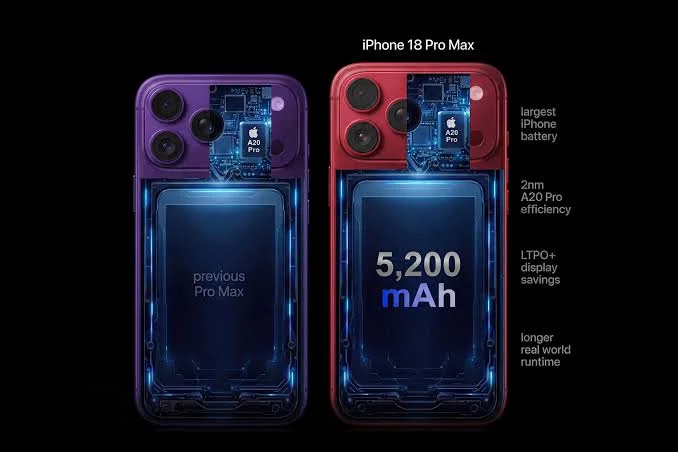
Recent leaks suggest the iPhone 18 Pro Max could get a noticeably larger battery than its predecessor. Reports from Chinese sources point to a 5,391 mAh cell for the physical-SIM version, while the eSIM-only US model is rumoured to use a larger 5,567 mAh battery. These figures have appeared across several reports based on leaked images and certification-related information, but Apple has not confirmed either capacity and will not do so until the phone is officially announced.
For now, the numbers are best treated as informed leaks rather than specifications. The more interesting question is what a larger battery would actually mean in everyday use.
What the Leaked Numbers Actually Show
The reported capacity would represent a meaningful jump over the iPhone 17 Pro Max. Its leaked and reported battery figures stand at around 5,088 mAh for the eSIM version and 4,823 mAh for the physical-SIM model. The iPhone 16 Pro Max, by comparison, used a 4,676 mAh battery.
- iPhone 16 Pro Max – eSIM: 4,676 mAh; Physical SIM: not sold with tray in most markets
- iPhone 17 Pro Max – eSIM: 5,088 mAh; Physical SIM: 4,823 mAh; Approx. increase: ~9%
- iPhone 18 Pro Max (rumoured) – eSIM: 5,567 mAh; Physical SIM: 5,391 mAh; Approx. increase: ~9–12%
If the 5,567 mAh figure proves accurate, it would be the largest battery capacity reported for an iPhone. That extra capacity may come with some extra physical bulk. Ice Universe has claimed the phone could measure roughly 9mm thick and weigh around 240 grams, compared with the reported 8.75mm and 233g of the iPhone 17 Pro Max. In other words, some of the expected battery gain may come at the expense of a slightly heavier, thicker phone.
A Bigger Battery Is Not the Whole Story
Capacity is useful for comparing phones, but it does not tell you exactly how long a phone will last between charges. Processor efficiency, display power consumption, background activity, connectivity and thermal management all have a major influence on real-world battery life.
The A20 Pro chip is expected to move to a more advanced manufacturing process, potentially improving efficiency. Apple also makes power-management changes through iOS, so the final result will depend on the complete hardware and software package rather than the battery alone.
Usage still matters enormously. Gaming, 4K video recording, mobile data, navigation and high screen brightness can drain even a large battery quickly. Two people using the same iPhone can get very different results simply because their daily workloads are different.
If your current iPhone is already struggling to make it through the day, JD Phones can check its battery and charging performance before you decide whether replacing the battery or upgrading makes more sense.
How Fast Does an iPhone Battery Actually Wear Out?
Apple says batteries in recent iPhones are designed to retain 80% of their original capacity after a specified number of complete charge cycles, with newer models rated for up to 1,000 cycles under Apple's stated conditions. A charge cycle is cumulative rather than one trip from 100% to 0%. For example, using 20% of the battery on five separate occasions adds up to one complete cycle.
How quickly a battery reaches that point varies considerably. Someone who uses their phone heavily every day can accumulate cycles much faster than someone who uses it lightly.
Battery Health in Settings is therefore more useful than comparing your phone with a launch-week battery test. Maximum capacity tells you how much energy the battery can hold compared with when it was new, while actual daily performance tells you how that degradation affects your routine.
Lithium-ion batteries inevitably lose capacity with age and use, but the rate is influenced by temperature, charging behaviour, workload and the number of cycles.
Protecting the Battery: What Actually Helps
Heat is one of the biggest things to avoid. Leaving an iPhone in direct sunlight, on a hot car dashboard or in a warm environment while it is charging can accelerate battery ageing. Heavy workloads that make the phone hot can have a similar effect.
There is also no reason to deliberately drain a modern iPhone to 0%. Lithium-ion batteries do not need regular full discharges. Charging before the battery is completely empty is perfectly fine.
Optimised Battery Charging can also help reduce the amount of time the battery spends sitting at a full charge. The feature learns charging habits and can delay the final part of charging until it expects the phone will be needed.
Use reliable, undamaged charging accessories as well. A poor-quality or damaged cable can cause unreliable charging and, in some cases, excessive heat. The concern is less about a particular brand and more about using accessories that are safe and in good condition.
Keeping iOS reasonably up to date is worthwhile too. Software updates can include power-management improvements or fixes for bugs that cause unusual battery drain.
Fast charging itself is not automatically harmful. The bigger concern is heat. Rapid charging in a hot environment can create more thermal stress than charging at a lower temperature.
Cold Weather Does This Too
Heat gets most of the attention, but cold weather can temporarily affect an iPhone battery as well. When temperatures fall below the battery's normal operating range, the phone may appear to lose charge faster, perform less reliably or even shut down unexpectedly.
That does not necessarily mean the battery has permanently failed. Once the phone returns to a normal temperature, performance will usually recover.
The distinction matters. If the phone behaves normally indoors but struggles outside in freezing conditions, temperature may explain the problem. If it continues draining rapidly or shutting down at normal room temperature, the battery or another component may need closer inspection.
Signs the Battery Actually Needs Replacing
A noticeable reduction in runtime, sudden percentage drops, unexpected shutdowns or unusual warmth during light tasks can all point towards battery trouble.
However, Battery Health should not be treated as an automatic replacement trigger. An iPhone showing 83% maximum capacity may still perform well for a particular user, while another phone with a similar reading might have serious runtime problems.
The percentage is useful, but symptoms matter too.
It is also worth diagnosing the problem before paying for a replacement. A charging-port fault, damaged cable, background software process or other hardware problem can sometimes produce symptoms that look like a worn battery. Replacing the battery in that situation will not solve the underlying issue.
Our Take
The iPhone 18 Pro Max could deliver a worthwhile battery-life improvement if the leaked capacity figures and efficiency gains both prove accurate. But until Apple announces the phone, claims about its exact capacity, weight, thickness and runtime remain unconfirmed.
For existing iPhone owners, the same basic battery advice still applies: keep the phone cool, avoid unnecessary full discharges, use reliable charging accessories and pay attention to changes in real-world performance.
At JD Phones, we diagnose before recommending a repair. If a battery is genuinely the problem, replacing it makes sense. If something else is causing the drain, the diagnosis should identify that before you spend money on a battery.
If your iPhone is showing shorter battery life or charging problems, contact JD Phones in Newcastle, Sunderland or Heaton, or use the UK-wide mail-in repair service.
Frequently asked questions
Will the iPhone 18 Pro Max beat the 17 Pro Max on battery life?
Probably, if the reported larger battery and expected efficiency improvements both materialise. Exact battery-life figures cannot be confirmed until Apple releases the phone and independent testing is available.
How long should an iPhone battery last before it noticeably degrades?
There is no fixed lifespan. Apple rates newer iPhone batteries for retaining 80% of original capacity after up to 1,000 complete charge cycles under specified conditions. Actual degradation depends on usage, temperature and charging habits.
Does charging to 100% wreck the battery?
No. Charging to 100% occasionally is not a problem. The greater concern is leaving a battery at a very high state of charge for long periods, which is one reason Apple provides Optimised Battery Charging.
Is fast charging bad for battery health?
Not inherently. Heat is the bigger concern. Fast charging in a hot environment can create more thermal stress than charging in cooler conditions.
Should the phone run down to 0% before charging?
No. Lithium-ion batteries do not benefit from regular full discharges. Charging whenever convenient is fine.
What percentage means it is time for a new battery?
Around 80% is a useful reference point, but it is not an absolute rule. Actual runtime, unexpected shutdowns and other symptoms should also be considered.
Can cold weather cause permanent battery damage?
Cold can temporarily reduce battery performance and cause unexpected shutdowns. If problems continue after the phone returns to normal temperatures, the battery or another component should be checked.
Is it cheaper to replace the battery or buy a new phone?
If the battery is the only problem, replacement is normally far less expensive than buying another phone. A diagnostic is worthwhile first so you know the battery is actually responsible.
Repair decisions are easier with the right diagnosis
The right repair starts with a clear diagnosis. If your device is cracked, draining quickly, not charging, overheating, water damaged, or simply unreliable, JD Phones can inspect it, explain your options, and help you choose the repair that makes sense.